

By Rose Sudworth
A place hard to get to, you say? Well in early December, Olivia Jacka, Maggie Booker, Roisin Blundell-Dorey, Emily Prout, and I set off on our long-planned trip to the Olivine Ice Plateau, where numerous people had told us it was hard yakka to access. In the months prior, we had secured an expedition grant from the Federated Mountain Clubs, been busy discussing route options (Emily gathering lots of Beta), gear lists, our preferred Backcountry dehy flavours, and nailing our crevasse rescue skills. As the metvuw forecast and our annual leave/resignations/graduations had finally aligned, we headed south and got moving!
The expected faff of setting off on a tramp meant we didn’t start till after lunchtime on day 1. Key pieces of kit left in Christchurch led to a surprise shopping trip in Queenstown, and the car swap between Chinamans Bluff and Lake Sylvan campsite contained some rather adventurous ford crossings for our low-lying cars.
Despite the blue skies, forecasted winds at the start of our weather window had diminished our plans of doing the high route to the Plateau over the Barrier Range, so we reversed our route and trudged along the Beans Burn with hopes of coming out via Barrier Range in ten days time. Our packs felt unreasonably heavy and travel was pretty slow, leading to occasional blips in morale.
Day 2, we continued along the Beans Burn, vowing to never return to this valley (maybe dramatic, but it was such a slog). We walked up to almost the head of the valley with the hopes of another high route up Irvine Peak the following day.
The morning of day 3 brought wind and rain, leading to discussions about our plan for the day, with Emily saying “It’s raining, go back to sleep.” No arguments from the rest of us, and after some extra sleep we backtracked a little and set off over Fohn Saddle, descending into a bush bash along the Olivine River and setting up camp at the confluence of the Olivine and Forgotten Rivers.
Leaving the Beans Burn and feeling truly off the beaten track had boosted morale, and the excitement of routefinding and new terrain was motivating for us all.
Day 4 led to more bush bashing, carefully following the very specific guidance presented in Moir’s Guide until we reached the easy travel of the Forgotten River as the valley opened up.
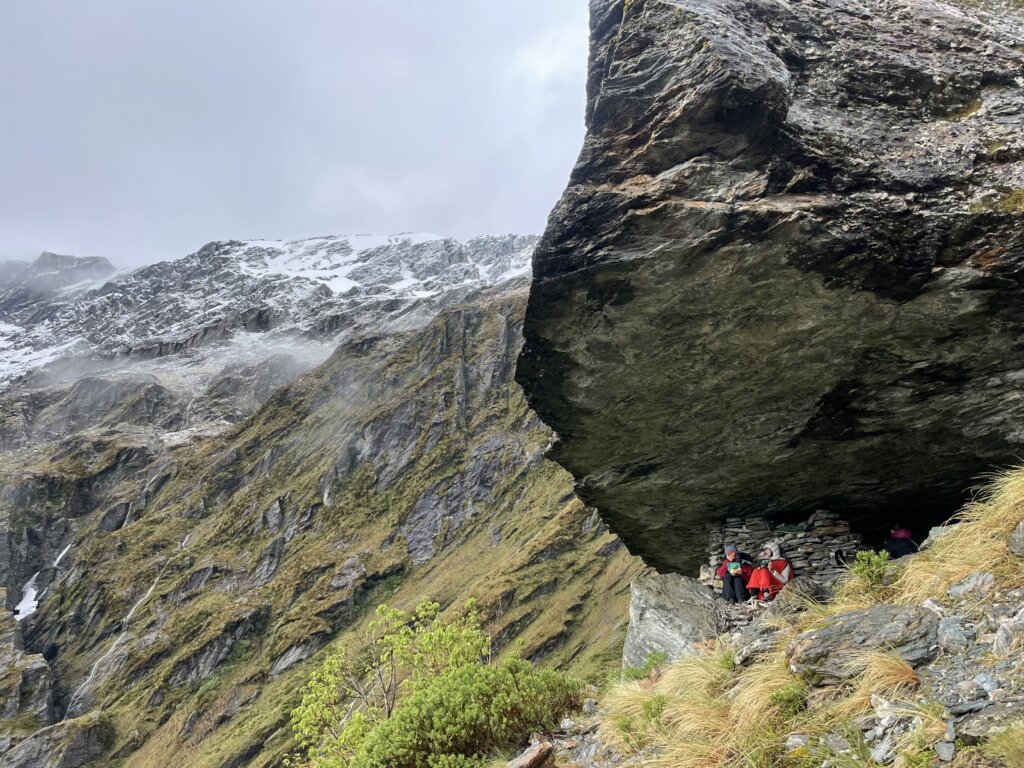
Rock Biv – Roisin Blundell-Dorey
We were delighted to arrive at the Forgotten River Hotel (i.e., Rock Bivvy), a sturdy and spacious cave with a bivvy book full of enthralling tales of other people’s adventures to the Olivine Ice Plateau.
Our most recent forecast showed two bluebird days ahead, followed by a day of gale-force winds, then two days of precipitation (also known as a big red blob on metvuw). We decided then, to make the most of the weather and head up to the Plateau for two days, and return to bunker down in the rock bivvy for the storm, this extending our trip by several days.
Somehow, it had all worked out, and we had secured two glorious days on the plateau. Leaving the bivvy early the next morning, we sidled under the bluffs and headed up Forgotten River Col, later fooled by several false peaks, then finally getting our first glimpse of the Olivine Ice Plateau! The Plateau was huge, with perspective playing tricks on us in terms of travel time, Roisin exclaiming that “this is taking ageeees!” We explored and ticked off Little Ark on day 5, and found a lovely rock outcrop to sit and admire the beauty of the plateau, even taking our boots off to dry them out (resulting in sunburnt toes for some of us).
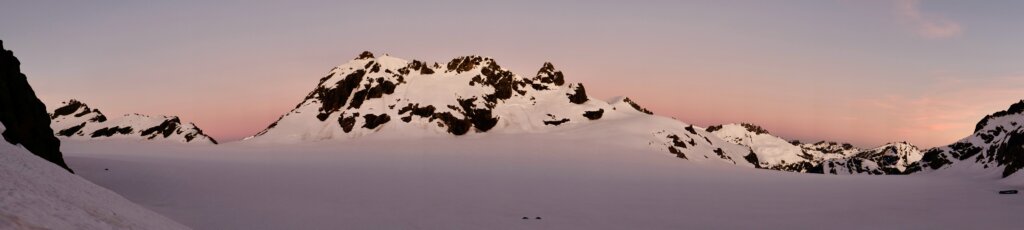
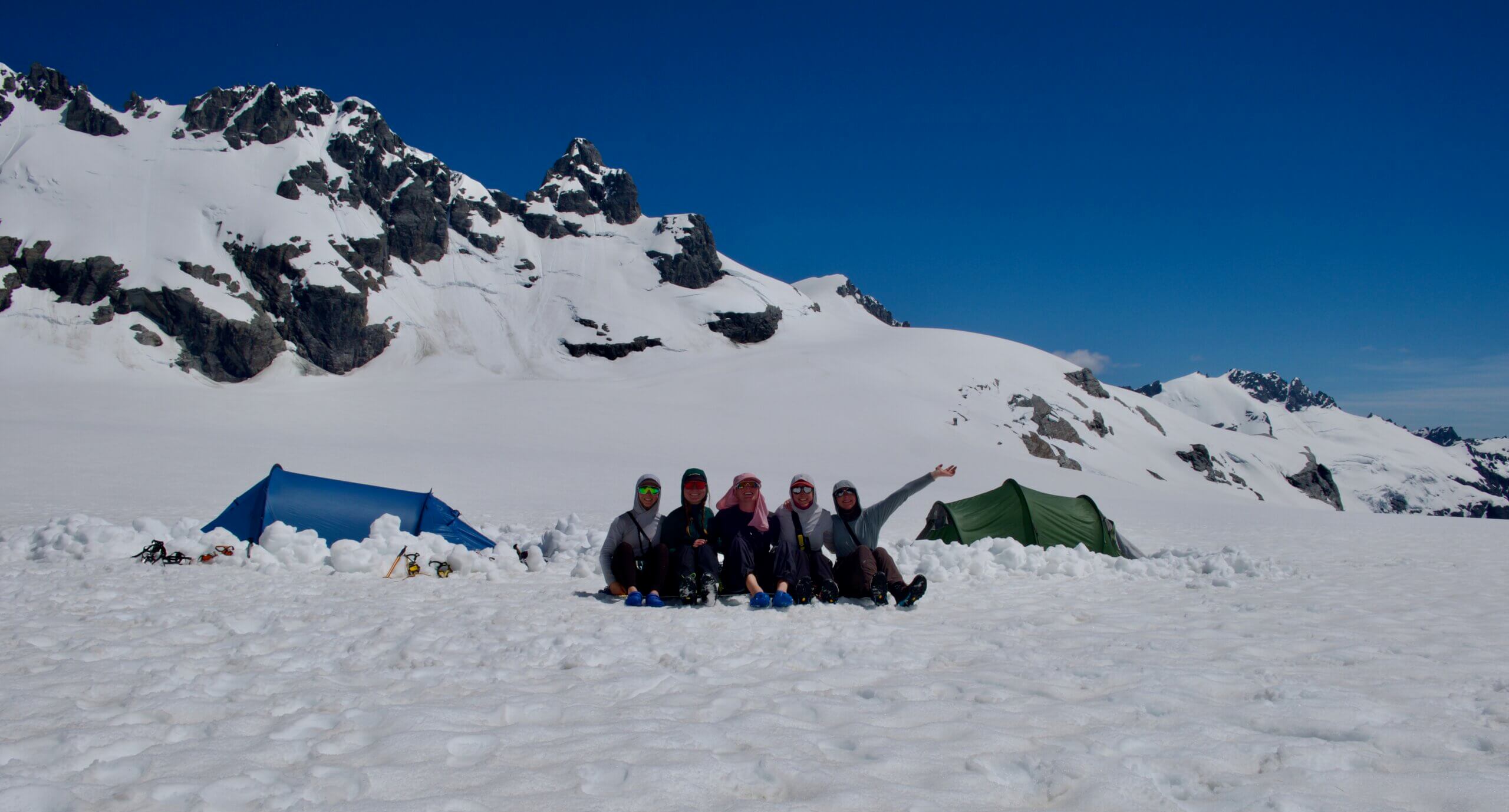
Tiny tents on the Olivine Ice Plateau, Intervention Ridge and The Tower in the background – Emily Prout
We set up camp below Passchendaele Peak, ready for a morning mission up Climax Peak.
The morning of day 6 was beautiful, with pink and purple skies delighting us as we walked over the Memorial Icefall and climbed up Climax Peak. Circled by magnificent views, seeing Tititea / Mount Aspiring, Mount Madeline and Tutoko, and the ocean all in one expansive panorama. After descending down Climax, we enjoyed the calm of the plateau at our tent spot for the rest of the morning, soaking up the rays before crossing the plateau back to Forgotten Col and down to the trusty rock bivvy. As we were crossing the Plateau for a final time, Maggie surprised us with a poem that she conjured up while we were walking.
“Itching for an adventure, five girls started a venture. Off to the Olivine Ice Plateau, where very few do go. But the weather would not play, so they decided to go anyway. They made new plans, they rationed their cans, until they made it to the land of snow. They had their fun, but their time was not done, I wonder what is next to come.”
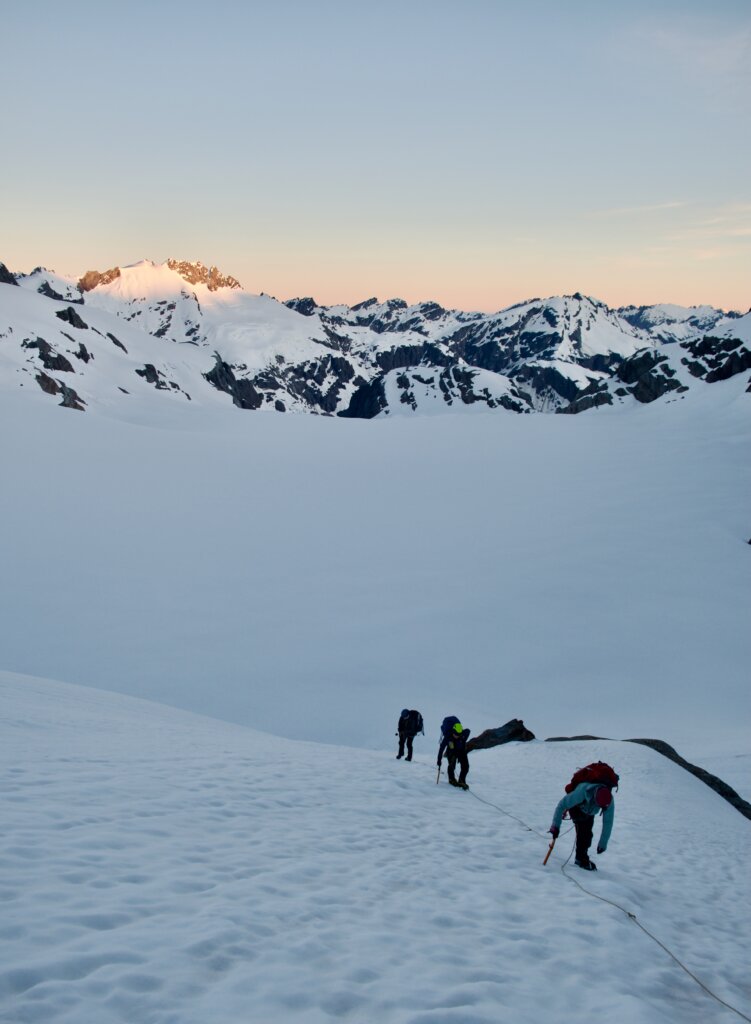
The morning slog up to Climax Peak – Emily Prout
Days 7, 8, and 9 were spent waiting out three days of wind, rain, and snow in our homely cave. Activities included writing in the bivvy book, counting food rations for the 10th time, staring into space, fending off cheeky keas, and pretending to cast spells to bring clear weather. A notable spell we chanted was “bippity boppity bluebird”. Bivvy life was bliss, but we left it on day 10, descending down Forgotten River then heading up a tussocky-turned-snowy slope leading to Angle Peak. It was here that we realised our witchy spells had worked, and we had summoned the hottest bluebird day, leading to horrific wet loose conditions given the snow fallen the day prior. We found a safe spot to wait out the heat of the day, in disbelief of our spell casting skills. After pitching the tent for some much needed shade, Olivia whipped up some ‘Electrolyte Snow Cones’, which are an alpine delicacy I’d recommend making if you’ve never tried one.
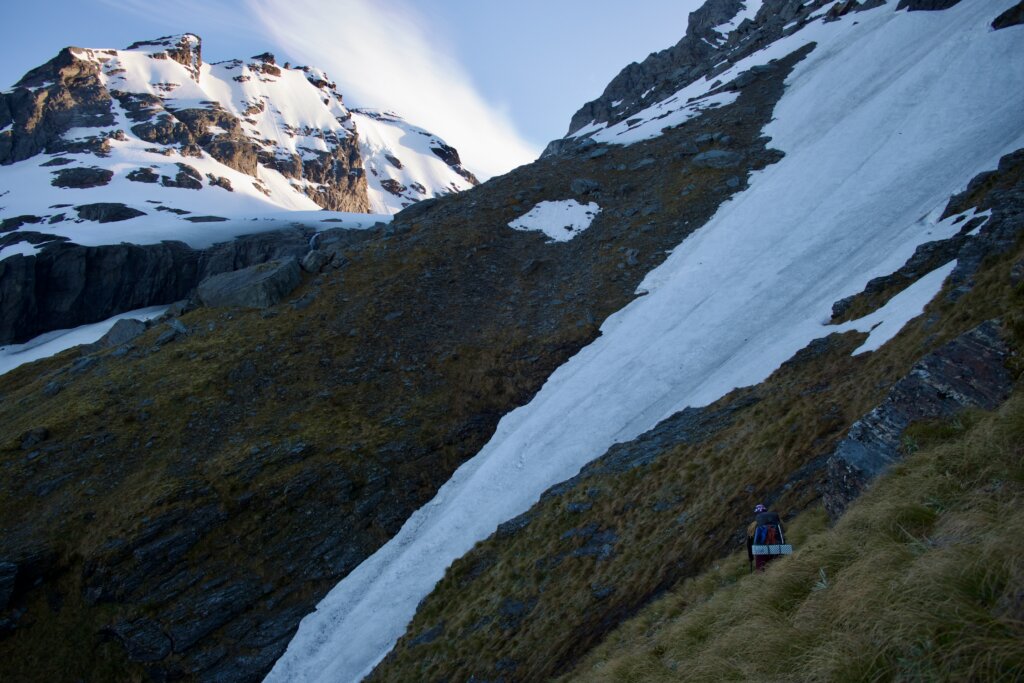
Ascending tussock and icy slopes to access the Forgotten River Col and the Olivine Ice Plateau – credit Emily Prout
Wondering if we should’ve chosen another route out, we referred back to some photos I’d taken of Moir’s Guide, looking at the beta for heading out the Olivine Gorge to the Pyke. After reading an excerpt from 1864 in which a group almost lost a team member to a “fearfull boiling eddy” after lowering him on a flax rope that subsequently snapped, we decided our decision-making wasn’t so bad after all.
After some time, evening came, and we continued on to sidle around Angle Peak and descend the ridge down to Four Brothers Pass. It was sweet relief once we saw the route would go, as turning around and heading out the way we came had been weighing on our minds. This was our first and only ‘benighting’ of the trip, and other than Olivia double-ejecting from her crampons, all went relatively smoothly! The Four Brothers Pass is now the Five Sisters Pass in our minds. We scree-sloped and boulder-hopped our way down to Diorite Stream where we set up camp for the night. On day 11, the five of us sleep-deprived girls had gnarly west coast bush for breakfast and lunch as we made our way from Diorite Stream down into the Pyke, to meet the Olivine River and cross the Olivine Cableway, a magnificent piece of machinery. We enjoyed the shelter of the Olivine Hut whilst it bucketed down outside, blissfully unaware of what was to come.
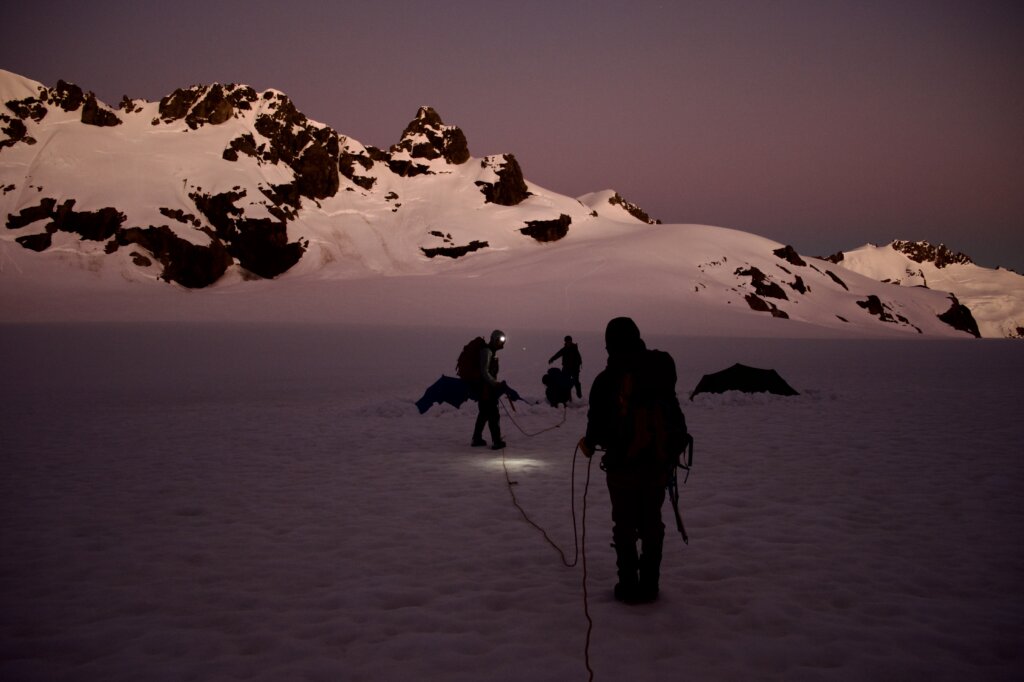
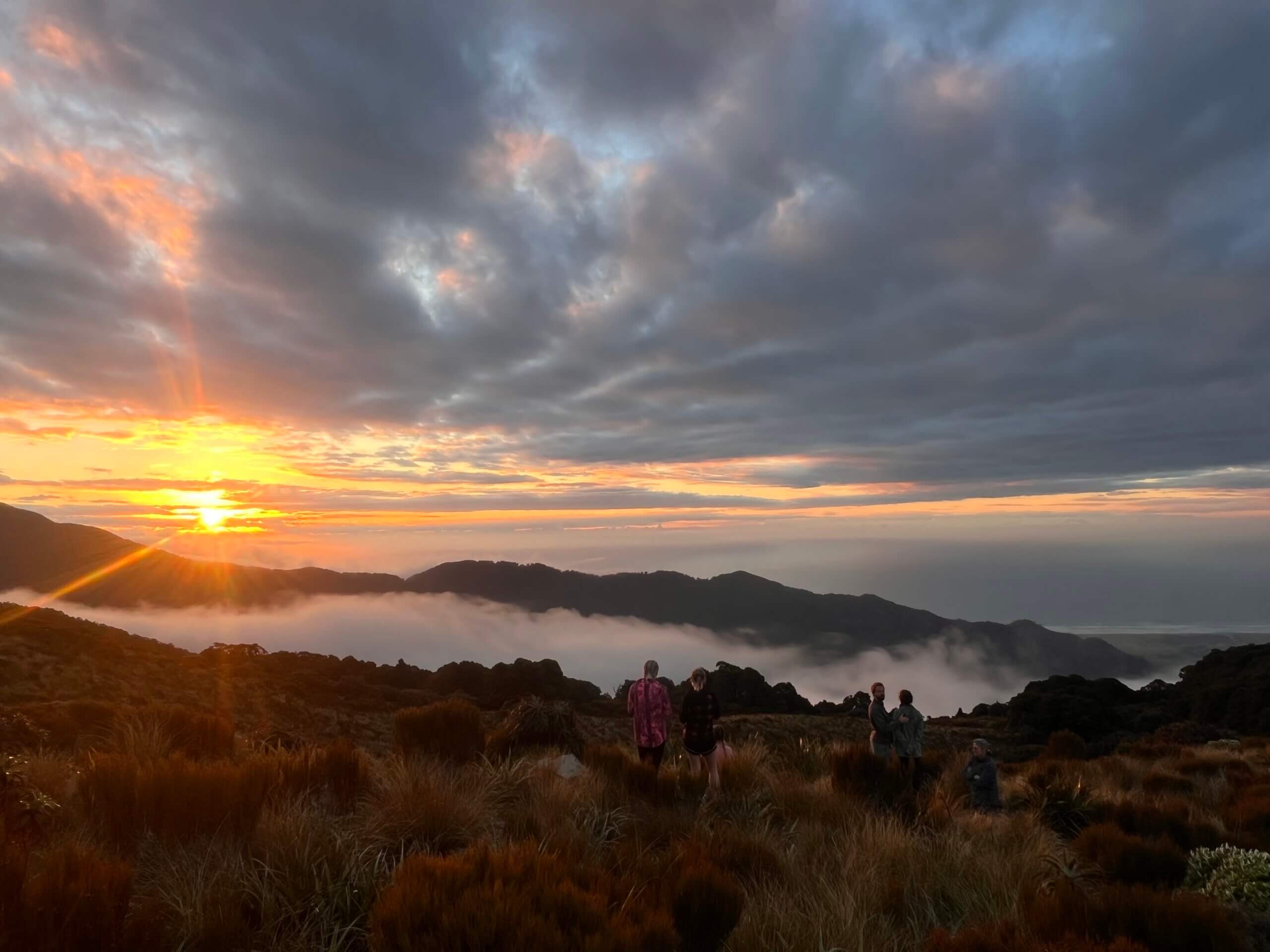
Morning light – credit Emily Prout
Now on somewhat of a track, on day 12 we left the hut and after several hours walking along the banks of the Pyke River, came across a small tributary that had become a deep bubbling swamp. Safari style, we trudged around waist-high water, but in almost every direction the water became deeper, well over our heads, with a high-consequence swim that would lead us into the flooded Pyke River. Defeated, we decided it was impassable and returned to dry ground and sent some inreach messages to try and organise a boat or a helicopter out from the Olivine Hut as food rations were already stretched.
Responses read “no boats on the Pyke, heli coming to hut at 4 pm”.
A bit downtrodden at the prospect of having to get a helicopter out of here, we started heading back to the hut. Not long into our backtracking, we hear the murmurs of a motor from down the river.
“Is that a boat?” Olivia says, “No, keep walking”, replies Emily. As the sound got louder, we all agreed that it was indeed a boat, and we started running back towards the river. The boat gets closer, and we see it is steered by a grey-haired man in stubbies and gumboots, and he pulls up on the river bank.
After the initial confusion of ‘how did he know we were here, is he looking for other people not us, no it must be us ’, we hopped in the boat after telling our parents via inreach “a man with a boat has appeared! Cancel the heli”.
Pyke River legend Bruce had saved the day, and after a brief scenic tour round Lake Alabaster, he dropped us off at the Hollyford Track, and we started walking again, in disbelief of what had just happened.
Great Walk travel was speedy, and we found ourselves at Hidden Falls hut in no time. The next day we had a slow morning, trying to make the most of our final day on the trip, then continued out along the Hollyford. And that was it; we had walked, talked, and laughed our way to the Olivine Ice Plateau and back! By this point we were ready for a proper feed, so we hitchhiked onto Te Anau to find some food and debrief about the past 13 days.
We met some tourists from Argentina in the Hollyford Carpark, who, after we explained what we had done, said that “The women in New Zealand are the strongest in the world.”
We were all feeling strong, ecstatic to have completed the trip and extremely stoked that we’d done it together.
Despite some of us having only met once or twice before the trip, our group dynamic couldn’t have been better. We laughed through the stressful times, agreed on decision-making, and no one got left behind when they weren’t feeling their best. Being an all-female group, we all felt dialled into one another’s emotions and understood each other deeply, talking about all topics under the sun and enjoying experiencing girlhood in the outdoors with each other. Female friendships are a magical thing, and building those friendships while you trudge up dense bush and traverse icy slopes, then spend three days waiting out bad weather in a cave, is an unparalleled experience that I can’t wait to encounter again.
We’re delighted to share another trip report from recent recipients of the FMC Expedition Scholarship. Applications close annually in mid-September. For more details on how to apply, please visit the FMC website at www.fmc.org.nz/